
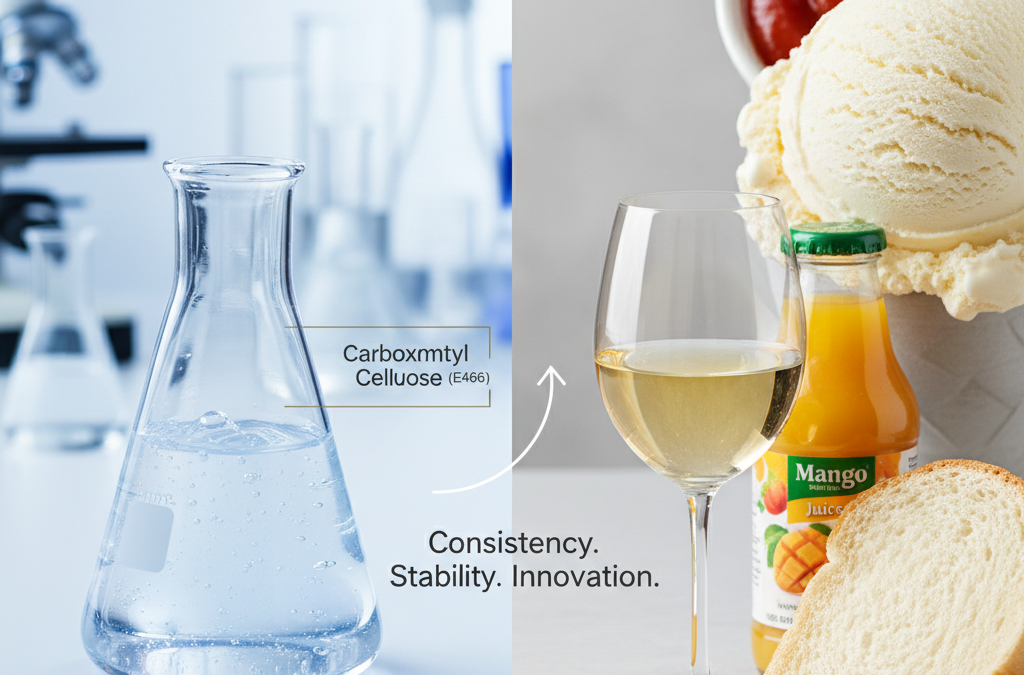
CMC (Carboxymethyl Cellulose), also known as sodium carboxymethyl cellulose or cellulose gum, is a widely used food additive coded as E466 in Europe (and similar approvals globally, including GRAS status by FDA). It’s a water-soluble, anionic polysaccharide derived from natural cellulose (e.g., wood pulp or cotton) through chemical modification. CMC is odourless, tasteless, non-caloric, physiologically inert, and highly versatile due to its excellent water solubility, thickening ability, and stability across pH and temperature ranges.
In the food and beverage industry, CMC functions primarily as a:
- Thickener — Increases viscosity for better mouthfeel and consistency, especially in low concentrations.
- Stabilizer — Prevents separation, sedimentation, or phase splitting (e.g., oil/water emulsions or pulp settling).
- Emulsifier — Helps blend immiscible phases and maintains uniform texture.
- Water-retaining/moisture-binding agent — Retains moisture to extend shelf life, prevent drying, and improve softness.
- Suspending agent — Keeps particles (e.g., fruit pulp, proteins) evenly dispersed.
- Texture enhancer — Improves creaminess, smoothness, and overall sensory properties.
- Other roles: Film-forming, gelling (in some viscosities), anti-crystallizing, and rheology modifier.
These properties make CMC ideal for clean-label, low-fat/reduced-calorie, gluten-free, or plant-based products, often replacing or complementing gums like guar, xanthan, or pectin.
Key Applications in Food and Beverages
CMC is used across a broad range of products, with typical dosages of 0.1–1% (often 0.2–0.8%) depending on the grade (low/medium/high viscosity) and desired effect.
- Beverages (fruit juices, carbonated drinks, milk teas, plant-based milks like soy/coconut/almond, protein shakes, sports/functional drinks, cocoa/acidic milk drinks):
- Stabilizes pulp, pigments, or proteins to prevent sedimentation or ringing at the neck.
- Improves mouthfeel (smoother, refreshing taste), suspends solids evenly.
- Prevents separation in acidified or protein-rich drinks; compatible with UHT/pasteurization.
- Dairy and non-dairy products (yogurt, flavored milk, soy milk, peanut milk, lactic acid drinks, processed cheese):
- Prevents whey separation/layering, enhances creaminess and stability.
- Provides uniform texture and extends shelf life in acidic environments.
- Ice cream and frozen desserts:
- Inhibits large ice crystal formation for smoother, creamier texture.
- Controls meltdown, improves overrun and mouthfeel (often at ~0.5%).
- Bakery and confectionery (bread, cakes, biscuits, cookies, pastries, fillings, jellies, gummies, candies):
- Retains moisture to keep products soft/fresh longer, reduces staling.
- Improves dough handling, volume, crumb structure, and reduces crushing in instant/frozen items.
- Sauces, dressings, condiments (mayonnaise, salad dressings, ketchup, jams, peanut butter, soy sauce, gravies):
- Thickens for better spread ability and stability; prevents oil separation.
- Maintains emulsion uniformity and improves texture.
- Instant and convenience foods (instant noodles, soups, puddings, powdered mixes, ready-to-eat meals):
- Enhances rehydration, prevents clumping, improves texture upon preparation.
- Other (meat products, canned foods, syrups, low-calorie/diet foods):
- Binds water/fat, improves juiciness/texture, and supports reduced-fat formulations.
CMC’s pseudoplastic behaviour (viscosity decreases under shear, e.g., when pouring or eating) gives products a natural, non-sticky feel. It’s heat-stable, acid-resistant (useful in fruit/acidic items), and works well in combinations with other hydrocolloids.
Overall, CMC is one of the most essential and cost-effective additives in modern food processing, supporting product quality, shelf stability, and consumer appeal in processed and functional foods/beverages. If you’re formulating for a specific product (e.g., in South Africa, where import/regulatory aspects apply), or need details on grades/suppliers
CMC – Wine Industry
Primary Use: Tartaric Stabilization
- Mechanism: CMC inhibits the nucleation and growth of KHT crystals by adsorbing onto crystal surfaces, disrupting their formation, and blocking further precipitation. It provides instant or long-term cold stability without needing traditional cold stabilization (refrigeration for weeks).
- Advantages over traditional methods:
- Energy-efficient (no prolonged chilling required).
- Faster processing (can be added late in production, even pre-bottling).
- Cost-effective and effective at low doses.
- Stable in acidic conditions and heat-resistant.
- Dosage: Typically 10–200 mg/L (often around 100 mg/L or 100 mL/hL for liquid forms), depending on regulations, wine type, and product (e.g., maximum 200 mg/L in EU for certain wines).
- Regulatory status: Approved by the OIV (International Organisation of Vine and Wine) since around 2008–2011 for white, ros?, and sparkling wines (initially focused on white/sparkling, later extended in some regions). It’s permitted in many countries, including the EU, Australia, South Africa, and the US (as a food additive). Always check local regulations (e.g., in South Africa via SAWIS or DAFF).
Specific Applications by Wine Type
- White wines and sparkling wines (including base wines for cava, Prosecco, or bottle-fermented styles): Most effective and commonly used here. Provides reliable protection against tartrate precipitation, even in higher-alcohol wines.
- Ros? wines: Effective in many cases, but bench trials are recommended due to potential minor color impacts. Use was re-authorized in some regions (e.g., EU for certain products post-2022).
- Red wines: Less commonly recommended or effective in some studies due to interactions with phenolics (can cause color precipitation or reduced efficiency). However, recent research shows it can work well for tartrate-unstable reds, especially with higher substitution degree CMC, with minimal impact on phenolic composition, chromatic characteristics, or color stability when properly selected.
Other Potential or Secondary Effects
- Foamability in sparkling wines: When added at dosage (liqueur de tirage or expedition), CMC can influence foam properties in bottle-fermented sparkling wines (some studies show effects on foam stability or persistence).
- No major impact on sensory qualities: Generally neutral on aroma, flavor, or mouthfeel at proper doses; may slightly improve smoothness in some contexts.
- Interactions and precautions:
- Wines must be protein stable first (CMC can cross-link with proteins and cause haze).
- Bench trials essential to check effectiveness, filterability, colour stability (especially in ros?/red), and no unwanted haze.
- Combine with other stabilizers (e.g., metatartic acid, mannoproteins, or potassium polyaspartate) in some protocols.
- Not a health concern (derived from natural cellulose, GRAS status).